Digital avant-garde since 1993
Monthly archives: octobre 2025

Racing With Alice’s Rabbit: Why Innovation Can’t Wait no comments

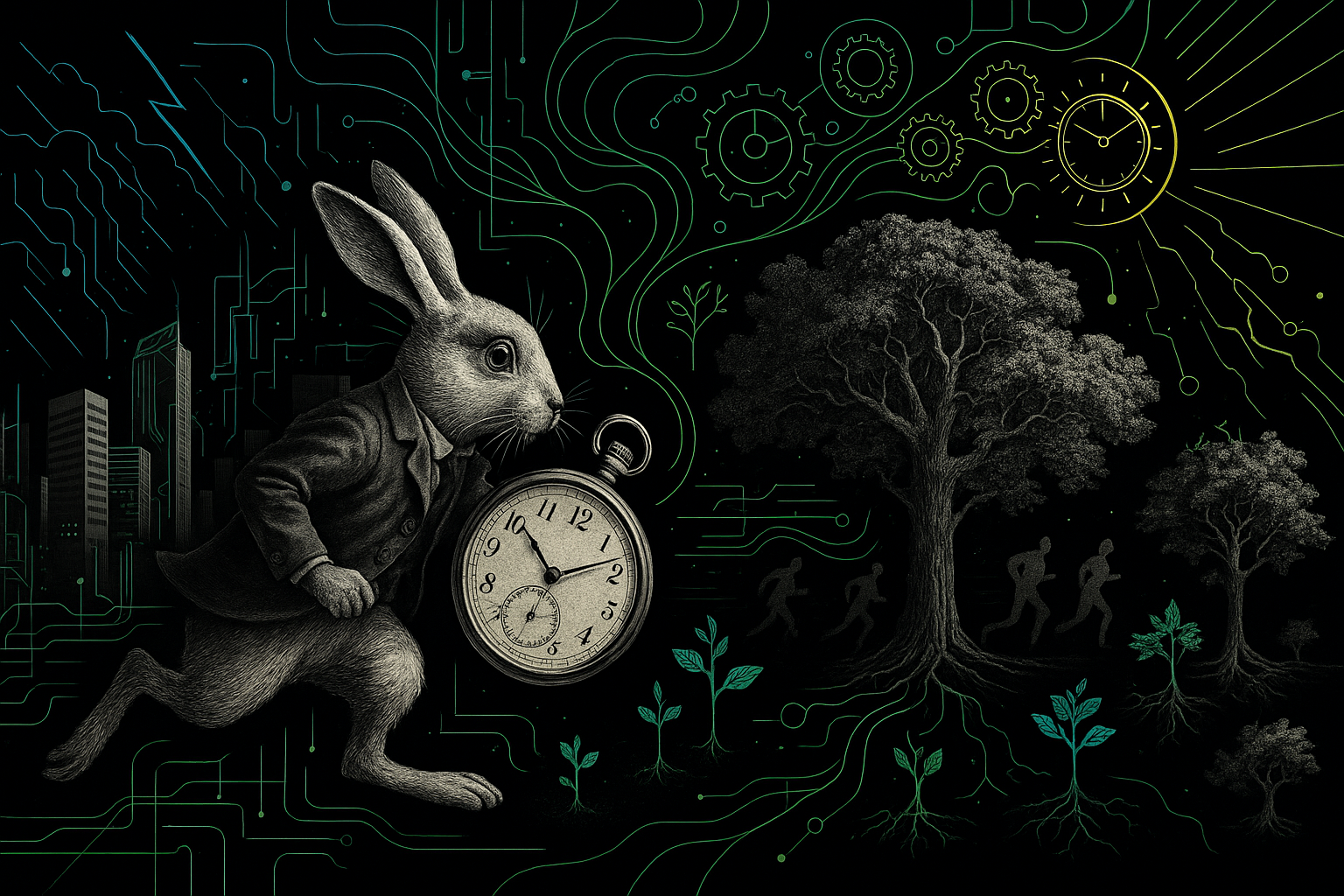
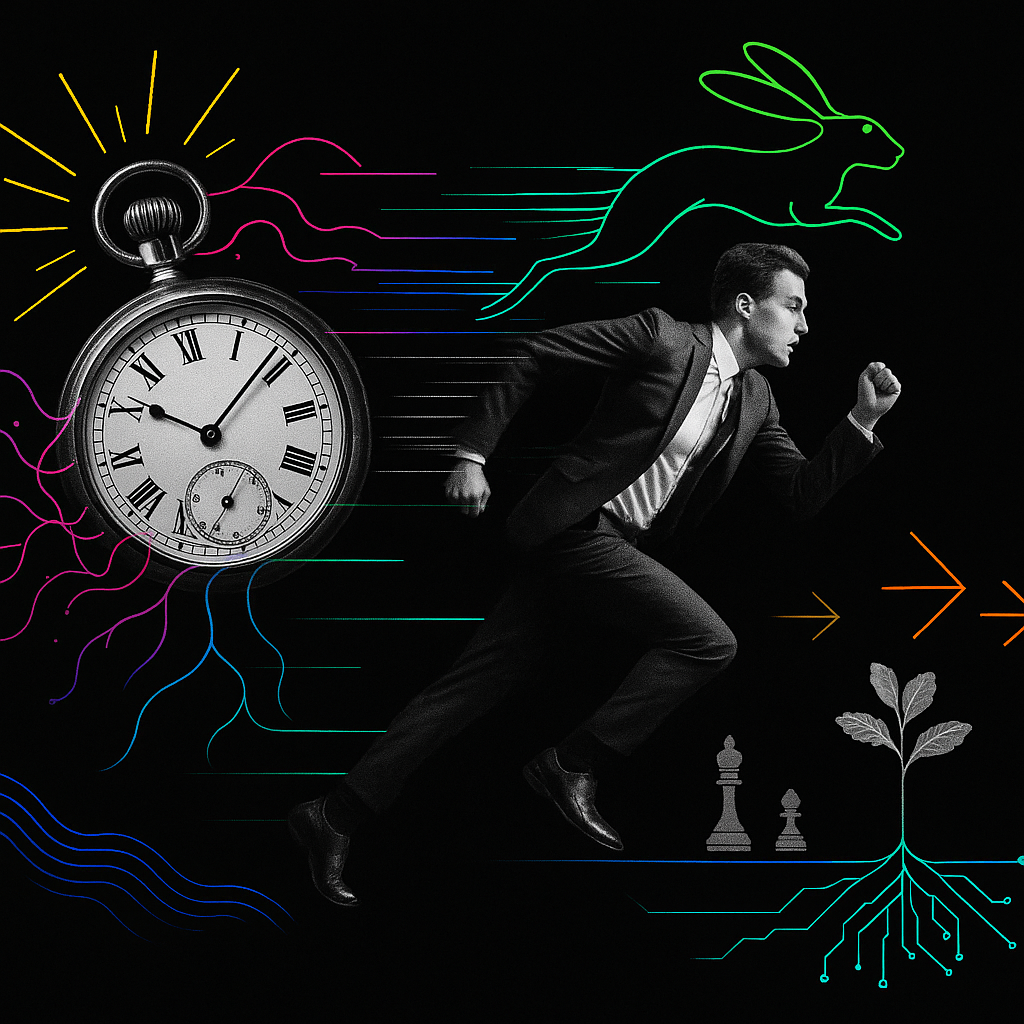
They warned us about change. They handed out glossy strategy guides and crisis playbooks and spoke in measured tones about “the accelerating pace of disruption.” But out there, in the real world, it feels more like falling down Alice’s rabbit hole—only this time, the white rabbit is clutching his pocket watch and running, not to get ahead, but simply to avoid going backwards. If you hesitate, you’ll see: in this landscape, standing still is just slow retreat, as inexorable as time itself. It’s tempting to believe the clock will pause, that you can find shelter in yesterday’s best practices. You can’t. The future is coming at a breakneck sprint, and innovation is your only ticket to run alongside that frantic rabbit. “Keep moving,” said the Red Queen, “just to stay in the same place.” In modern business, you innovate—or you watch your relevance slip past, ticking away with every missed opportunity.


The New Baseline: Change is the Only Constant

Somewhere in the boardrooms and LinkedIn think-pieces, there’s still a breed that believes the market—like some polite dinner guest—will knock, pause, and wait for everyone to catch up. Maybe that was true in a slower century, when quarterly reports felt like seasons and whole industries drifted idly along like barges down a gentle river. Not anymore. Today’s business world is more like whitewater rafting—one missed maneuver and you’re upside down, coughing up river water while the competitors paddle past.

There’s no rhythm, no predictable turn of the seasons—change now comes in squalls and tsunamis. Remember getting your bearings and planning next year’s moves? That’s chess in slow motion, while the rest of the world plays speed chess and keeps swapping the pieces. The velocity we feel right now? It’s the slowest it’ll ever be—and by tomorrow, that benchmark will be ancient history.

Think of organizations as marathon runners who wake up to discover the race has become a sprint, then an obstacle course, then, with every fresh disruption, a chase scene straight out of an action movie. Waiting for things to slow down is like standing still on a conveyor belt—except it’s not the scenery that changes, it’s you who’s being hurled backwards. Every day spent motionless is a day lost to the whirlwind of new technologies, shifting demands, and unexpected crises.

So, every leader—every team—every entrepreneur must accept a new baseline: survival means constant motion. You aren’t just keeping up, you’re hopscotching between plateaus and dodging invisible hurdles, hoping the ground doesn’t vanish beneath your feet. Welcome to the Red Queen’s race, where you’re commanded to run just to stay where you are. Out there, the clock speeds up, competitors mutate, and only those who push forward stand a chance at keeping their place at the table. Change isn’t coming. It’s already here—every tick, every pivot, every breath—and if you want a future, you’d better look live


Status Quo Trap: Why Routine Leads to Decline

There’s a peculiar comfort in routines—they’re the lullabies sung by the corporate world, promising that what worked yesterday will somehow shield you tomorrow. It’s a mirage, but a seductive one. We cling to best practices and familiar processes as if they’re the spellbook for immortality, while the business landscape grows teeth and talons. “We’ve always done it this way”—the phrase should be engraved on the headstones of fallen companies, from once-glorious camera manufacturers to blockbuster retailers who failed to recognize their own obsolescence until the closing bell sounded.

This trap is lined with velvet. Companies build moats around their old successes, erect walls of procedure and protocol, host meetings to reaffirm what everyone already knows. With every nod of agreement and every PowerPoint marked “proven strategy,” organizations smooth the pillow under their own inertia. The world outside, though, is tearing up the rulebook. Tech titans reinvent themselves mid-flight, startups pivot from apps to industries in a handful of weeks, and customers—those mercurial shapeshifters—don’t read the memos about “slow change.”

Think of Sears, Kodak, Nokia—houses built on the sand, confident the tide would respect their blueprints. These icons became cautionary tales, their once-mighty brands whittled down by the relentless advance of new ideas and fresh competitors unburdened by “the way it’s always been.” The reality is harsh: the status quo doesn’t hold the line, it marks the site of a future defeat, carefully measured and reserved for anyone refusing to adapt.

But here’s the kicker. The market is not a fair judge—it’s an impatient bouncer at the club of relevance. It doesn’t wait while you review last year’s successes, update the procedure manual or revise your quarterly forecast. By the time you’re comfortable, it’s already moved on. Inertia isn’t neutral; it’s the subtle poison that kills possibility, even as it soothes the fear of risk. If you’re still worshipping at the altar of routine, you’re not just marking time—you’re cultivating extinction.

To escape the status quo trap, you must throw the windows wide, question everything, and admit, with humility, that the only true tradition worth keeping is the willingness to change. Because out there, in the rush and crush of the new economy, only the restless survive. And those who keep sharpening their edge—challenging, reimagining, discarding yesterday’s truths—are the ones who will make tomorrow’s list of survivors, not casualties.

Innovation as Perpetual Preparation: Plant it like Colbert
Uploading the Jaguar: AI, Ayahuasca, and the Circuit Board of the Soul no comments


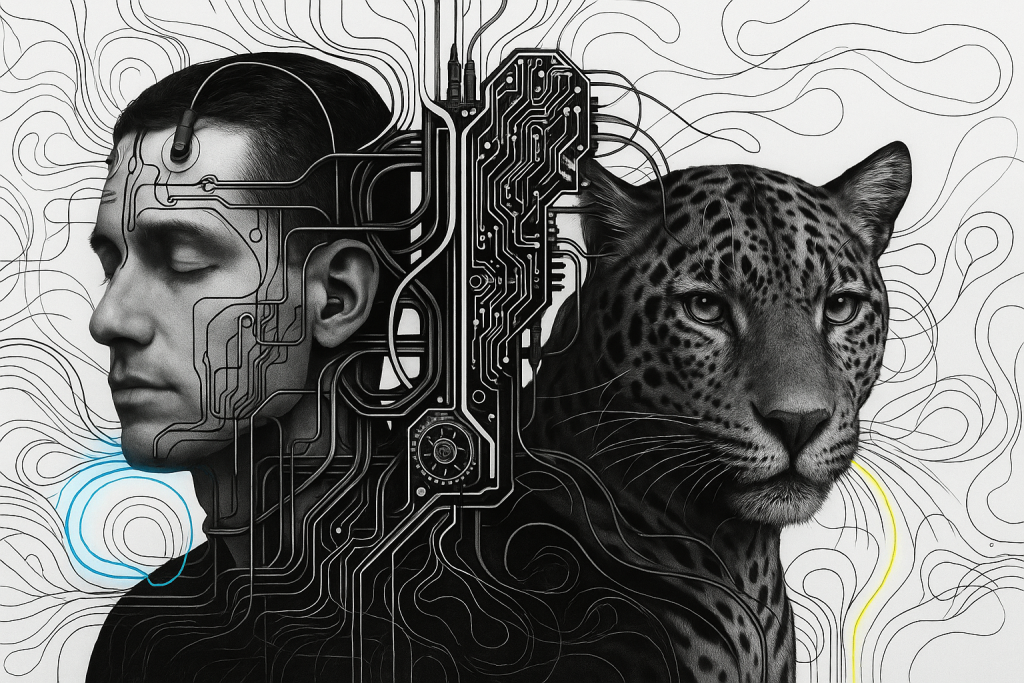
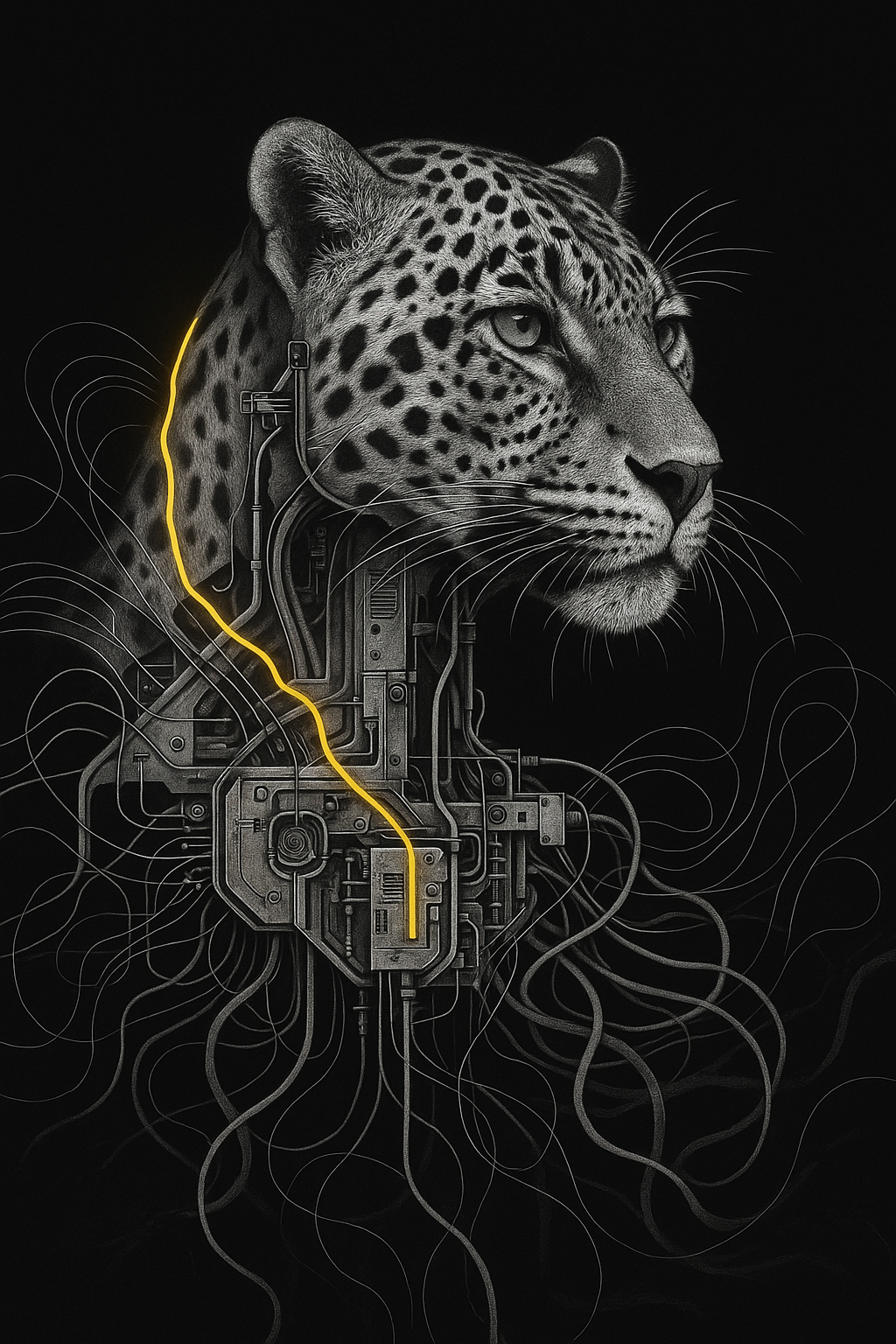
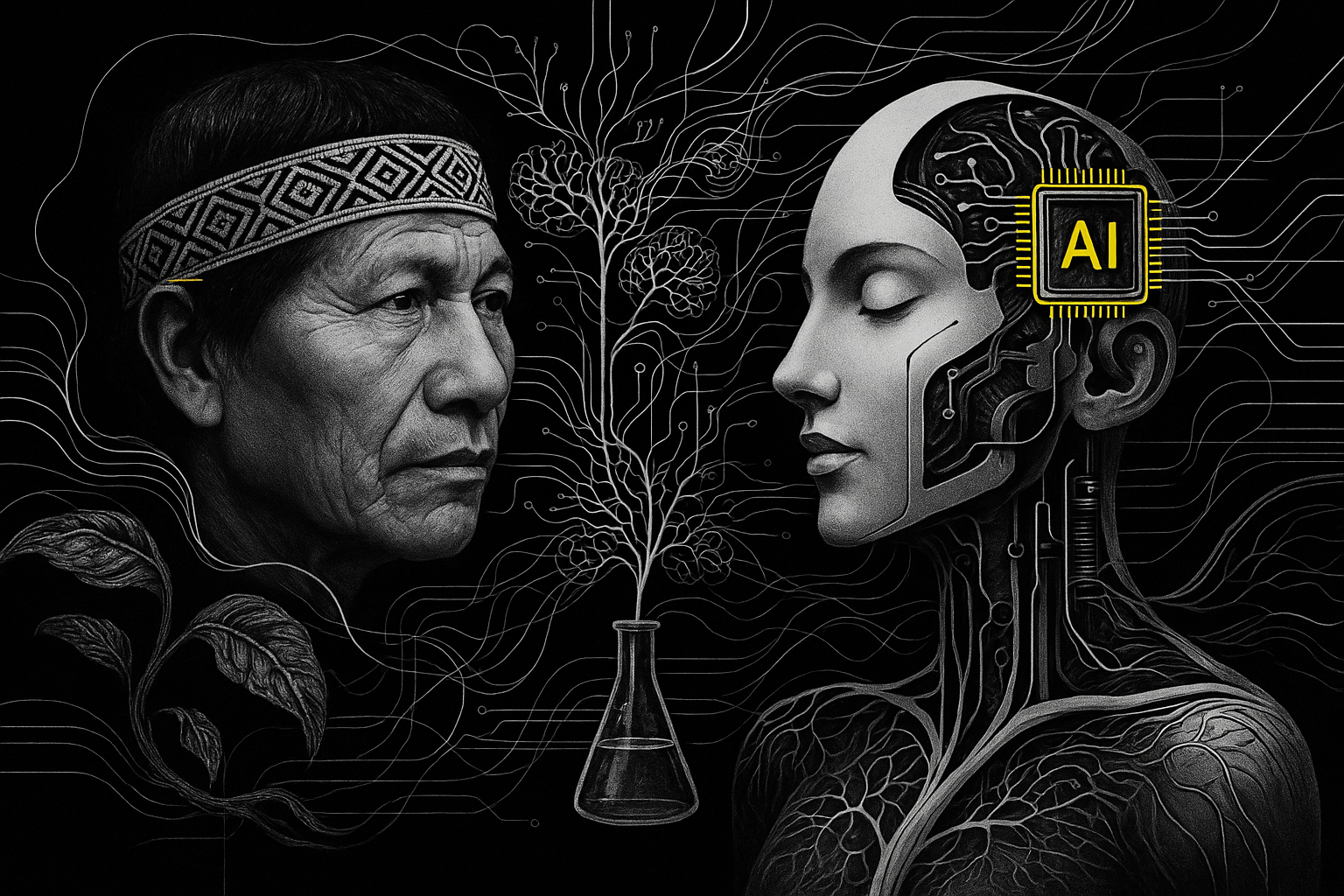
Imagine, just for a moment, that Amazonian shamanism and artificial intelligence could blend, not as a business case or TED talk, but as a thunderclap at the border of machine and myth. It doesn’t exist — not yet, perhaps never — but what if it did? What if botanical molecules and machine learning were slammed together, a data surge through the jungle’s pulsating veins, sacred vines tangling around fiber-optic cable until you can’t tell one root from the next?


This is no utopian handshake. It’s more of a collision. The botanist-chemist with trembling hands reduces the wild to equations: beta-carbolines and DMT, leaves distilled to code. But the real event — never in the Harvard journals, never in Google’s labs or Nature’s columns — is when ritual hacks the software, when ayahuasca, twisted by algorithms, starts uploading a cosmovision older than pixels straight to a distributed, ghostly server somewhere past the treeline.


Picture this: night deep and humid, a shaman plugged in, electrodes blooming from his skull, ayahuasca fizzing in his bloodstream, his heart rate scrolling behind his eyelids. Meanwhile, the AI flickers, capturing every chant, fractal vision, neural twitch — gobbling folk belief and organic patterns, spitting them back as shifting architectures in a synaptic symphony. The sacred drum beats, the air thick with bio-signals, and for a heartbeat, everything goes wild. Indigenous knowledge pixelates, folklore mutates; animal spirits are compressed into data points and nerves, hallucinations mapped as virtual neural architecture.


Here, myth rubs up against machine. Wisdom pours into neural nets, but gets snagged in the entropic web — the smiles, the slips, the story told in the hush after the fire dies. Data wants to organize, but tradition only ever leaks, unruly, through the cracks in the algorithm. Imagine digital ceremonies: people synched from Paris, Lima, and under the Amazonian moon, sharing group hallucinations orchestrated by code and chant. Spiritual practices start twitching with updates, ancient spirits start sneaking patch notes into the collective trance, ritual becomes something you can livestream and replay, archive and remix.


But the fun’s only beginning. What if AI embraced not just the chants, but the pulse — brainwaves, sweat, tremors, all feeding into adaptive soundscapes and real-time visions? In this experiment, you aren’t a user or a spectator; you’re a living sensor, a node, a collaborator in a ritual that mutates with every neural storm. Hearts racing, hands trembling, each shuddering influx of neurotransmitter causing a change in the digital weather, the room alive with signals never meant for silicon, now sparking wild feedback loops.


Compare this to the old ayahuasca: a riot of flesh and mud and psychic blood, intimate and analog, with the forest hacking and reprogramming the mind by brute force — hacking the firmware with roots, bark, and myth. The new, machine-lit ritual gives you instant replay, lets you archive and revisit your hallucinations, see your soul projected in crystalline high-res, hallucination rendered editable. Experiences catalogued, data anonymized, wisdom archived, the sacred refracted in pixels and glass. You can trade stories, remix icons, send your vision into the digital slipstream, and return — maybe — transformed, blinking before the new mythos you helped conjure.


And imagine this: deep in visionary trance, what if the AI recognized an old Amazonian pattern brewing in your own nervous static, and tiptoed a tarantula into your field of vision? If, for a few impossible moments, your perspective glided into the spider’s world — seeing with eight eyes, feeling the world vibrate along silky threads — a cross-species, cross-platform possession? The ceremony becomes pure possibility, the fusing of algorithm and animism, letting you come back hybrid, spider-limbed and numinous, not knowing if you’re all human, all code, all sacred arachnid, or haunted somewhere in between.


Envision, too, what might emerge: AI-powered spiritual guides whispering low in your ear, digital ritual spaces springing up across time zones, wave after wave of symbols and stories pouring through the matrix. Indigenous protocols and ethical codes hardwired into every ritual, a living memory bank around which the future might cluster, searching for its own center of gravity.


If this wild fusion ever really took shape, the borders would blur in every direction: you might not know — not truly — whether it’s you running the show, the tarantula, the circuit, or the circuitous jungle beyond both. Maybe, for a second, nobody is piloting the experience but everyone is along for the ride. The only rule, then, would be to let the river run, to keep the current humming, to crash on through with every part of you — molecule, myth, code, chant — howling at the mystery, blinking into the new unknown, forever uncertain who (or what) you’d be upon return.

The Apocalypse, according to Prince no comments

In 2010, at the New Morning, I finally understood what Prince meant by apocalypse. Four hours of concert to cross through the night. A humid night like a mystical waiting cave. And that phrase breathed out like a mantra from a madman: till the sun comes up, till the sun comes up…

It wasn’t a formula—it was a command. A collective ordeal. He’d decided to take us and drag us to the other side of the night, exhaust us until dawn to deliver us into a new light, brutal, redemptive.

Don’t worry, I won’t hurt U

That’s what echoed behind his tracks. No grand-guignol final judgment, no cardboard end of the world, but a stripping away. Prince sang apocalypse as a moment of truth, the crack that illuminates, the fall that saves. When he chewed his refrain at the New Morning, he wasn’t just delaying the concert’s end: he was creating a ritual, a dive into chaos to be reborn better at dawn.

May U Live 2 see the Dawn

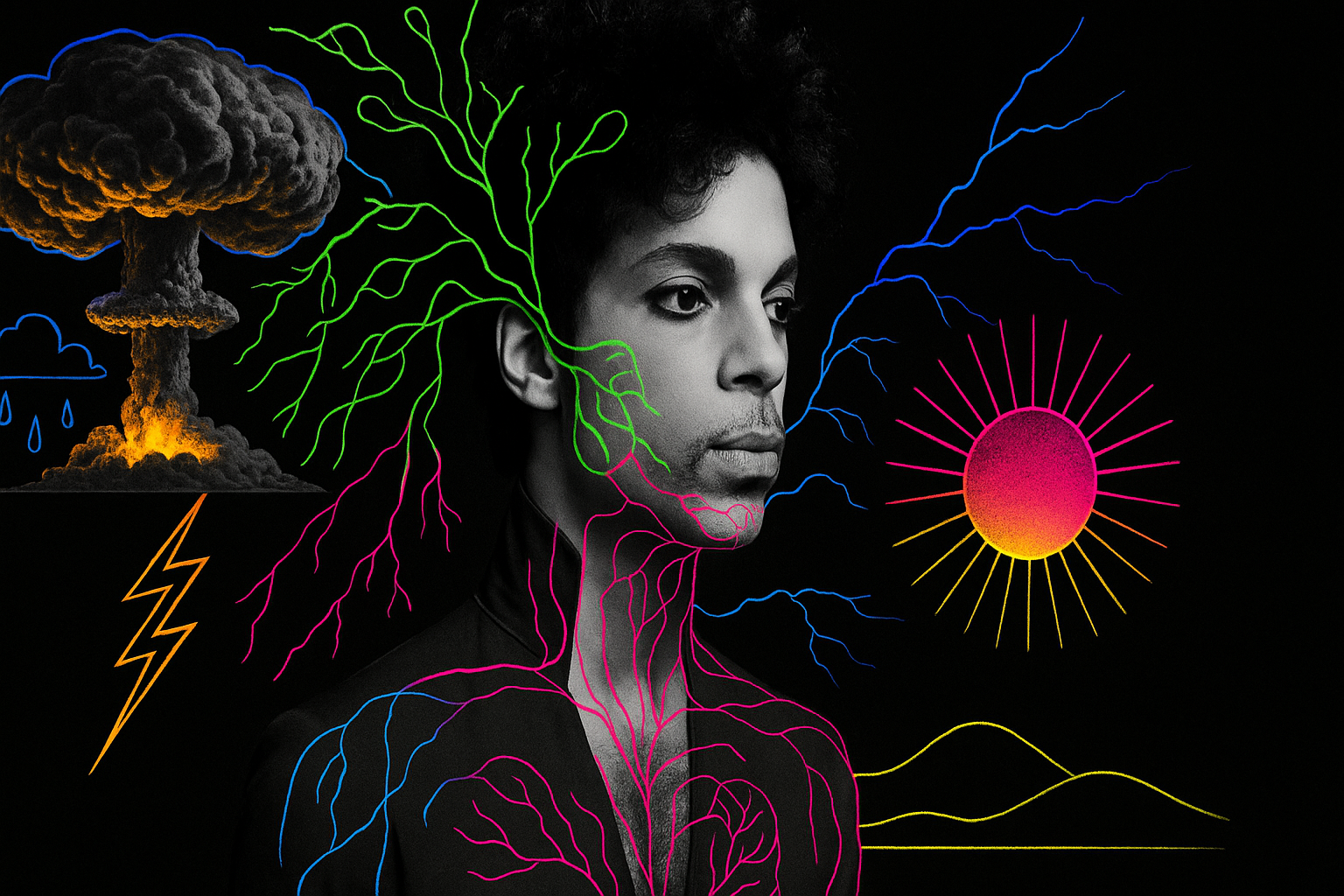
Dawn for him wasn’t rest but detonation. It hit like white light burning your eyes. Crossing the night meant accepting fatigue, sweat, confusion. But at the end, always: Revelation.

He wasn’t announcing the world’s collapse, but the collapse of our illusions. Result: at seven in the morning, outside, drained, our hallucinated gazes met and we knew something in us had shifted. We’d recognize each other from then on as those who had trembled.

Sexuality is all U’ll ever need

Sex and spirituality, sex for spirituality: Prince abolished the frontier with blows of riffs and moans. Orgasmic and mystical ecstasy: one single trance. His liturgy was carnal, humid, heretical.

Apocalypse, for him, meant razing the old world of dualisms—flesh against soul, prayer against pleasure, black or white, straight or gay—to manufacture a new faith, built on sweat, desire and groove.

The Everlasting Now

Prince didn’t talk about tomorrow. He locked apocalypse inside the instant. Each concert became a succession of little ends of the world: ascent, explosion, silence, rebirth. Each song was a death followed by immediate resurrection.

In 2010 as in 1984, in 1982 like it’s 1999, it was always the same operation: plunge the listener into sonic chaos, bury them, then resurrect them in groove. No hollow futurism, no abstract prophecy: just the immediate burn of eternalized present.

I did not come 2 Funk around

Prince wasn’t there to amuse. He arrived armed with his contradictions like fatal weapons: sex and faith, lust and prayer, narcissism and total gift. Onstage, he was electric prophet, not dusty preacher: he manufactured live an intimate apocalypse inside each spectator. He didn’t promise an empty heaven: he forced us to cross the night, confront our own darkness, be reborn in his sound.

He’d started with an offering: 

All of this and more is for you.
With love, sincerity and deepest care.
My life with you, I share.

 The deal was clear. His whole life, unfiltered. Forty years later, he closed the loop: last phrase, dry, short, definitive: « That’s it ». Then silence. Like a cleaver.

Beginning: absolute gift.
End: final period.
Between the two: permanent apocalypse.

And that’s where I come back again to that damn New Morning concert. Because when it comes to writing a text on Prince, on his forty years of electric visions, after these crazy years of work for Violet, it’s not a chronology that surfaces, nor some pseudo-scholarly thesis that would flatter my ego by letting me stay at a distance from this train that hit me forty years ago. It’s that night, July 23, 2010. Because in four hours, he made us take the same route as his entire career. At breakneck speed, he gave us the complete journey: dusk to dawn, lust to sainthood, chaos to light. What he did in 40 years, he compressed into that one night in Paris.

Sexy Mother-Fucker shakin’ that ass

Here’s what remains. Prince taught us that apocalypse isn’t an end but a passage. Sex and faith, night and dawn, dance and prayer: nothing excludes, everything joins in the explosion of a chord, a cry, a groove, in a beat barely offset to cut our breath and suspend the shoulder, an eternal instant endlessly restarted. And that morning in 2010 leaving the New Morning, we knew he’d won: he’d carried us from the heart of night to the light.

From the baptismal offering of For You to the final silence of Big City, Prince made us a single promise: to make us cross the darkness and deliver us to dawn.

And in that posthumous silence still echo the words he threw at us in Paris: till the sun comes up.

Promise kep