Printemps 1995,
Marié depuis quelques mois, en plein service militaire, je profite d’une permission pour aller rendre visite à ma soeur, au pair à New-York.
Ses employeurs sont partis dans leur maison de Key West et lui ont laissé l’usage de leur appartement de l’Uppper-West.
Au retour, 9h de transit à Heathrow, on a 23 ans, on trouve ca idiot de rester à l’aéroport. Direction Londres.
Et dans ce cybercafé de Tavistock Square, je me retrouve devant cet écran cathodique, pas loin d’un modem qui criait comme un insecte qu’on électrocute et c’est un monde qui s’ouvre en 56k.
Mon premier contact avec le Web. Je ne savais pas encore que j’allais passer trente ans à courir derrière cette brèche. Je ne consultais pas “une page web” (un site amateur sur Seinfeld, mais tout était amateur à l’époque); je touchais une membrane cosmique. Une surface vibrante derrière laquelle le réel se dédoublait. Ce n’était pas technique. C’était mystique. Une fissure dans la croûte du monde.
Depuis des années, j’essayais de connaître ce qui se cachait derrière l’évidence. Masqué, oublié, enfoui. Pas du tout comme ce qui deviendrait le complotisme, plutôt comme un archéologue du présent.
Les simagrées de Prince et de ses morceaux secrets m’avaient forgé l’esprit à grattter sous le réel.
Et voilà qu’une couche mondiale venait se superposer au monde.
J’ai toujours détesté cette dualité virtuel/réel.
Pour moi, la réalité est ce qui a un effet, ce qui nous touche, ce qui nous change.
Il me semble plus juste de parler de tangible et d’intangible. Cette page web, dans ce café londonien, était intangible mais tellement réelle.
Je ne me suis jamais intéressé au digital comme à un outil. Je l’ai senti comme une onde. Tectonique. Une énergie.
Le réseau n’était pas qu’une toile statique : c’était un système nerveux en train de pousser sous la peau de la planète.
J’avais vingt ans et la sensation d’être au bord d’un volcan calme qui allait, tôt ou tard, se réveiller.
Je voulais être au cœur du cratère. Pas pour observer. Pour participer à l’éruption.
Alors je m’y suis mis.
J’ai monté une boîte. Je bricolais des sites comme un chaman bricole des totems. HTML nu. Des lignes de code comme des incantations. Je pensais créer des vitrines. J’tais en train de batir des passerellses.
Derrière chaque page, une nouvelle géographie mentale. Je croyais à l’utopie naïve de l’interconnexion.
Cette époque était naïve et joyeuse. Google n’existait pas. Yahoo était un répertoire thématique, alphabétique et statique. Pour accélérer le référencement des pages que je créais pour mes clients, j’appelais le siège à San Francisco. Un type nommé Jerry Yang me répondait et ajoutait une ligne de code.
Plus de liens => plus de compréhension => plus d’empathie.
La carte allait civiliser le territoire.
Elle a surtout révélé ses cicatrices.
Le réseau n’a pas inventé la violence humaine. Il l’a amplifiée. Comme une pédale de distorsion branchée sur une guitare dont les cordes sont maltraitées.
Le monde s’est mis à hurler plus fort.
Et moi, au milieu, je continuais à construire. Parce que j’aime les architectures. J’aime comprendre les structures invisibles. J’aime démonter les mécanismes jusqu’à voir la trame sous la trame. C’est presque physique. J’ai besoin de voir comment les choses tiennent debout.
J’ai passé les trente dernières années à essayer de faire adopter les solutions qui sont derrière le rideau. Ce qui est en coulisses. Ce qui fait marcher la machine et ce qui la rend rentable. Parce que l’utopie libertaire a bien vite laissé la place au réalisme capitaliste.
Mais il y avait l’autre monde. Celui qui ne tient pas debout, justement. Celui qui tremble. Ces concerts dans des salles pleines à craquer. Corps collés. Sueur. Lmière qui découpe l’obscurité. Instant où l’artiste entre sur scène et tout bascule. Là, il n’y a pas d’architecture. Il y a une vague. Une vague qui traverse des milliers de thorax en même temps. C’est une synchronisation biologique. Une mise à l’unisson.
J’ai passé des milliers d’heures dans ces salles obscures et pourtant lumineuses à chercher cet égrégore. Rare et capricieux. Réalité intangible.
Parfois, au milieu d’un morceau, le temps se dilate. Les secondes deviennent épaisses. Les regards se croisent sans se connaître. On est ensemble dans quelque chose qui dépasse la somme des individus.
Je n’ai jamais retrouvé cette intensité dans une interface. Parce que ce n’est pas l’image qui compte. C’est la vibration. Le battement commun. C’est quand la musique dit I just want your extra time and your kiss et que la salle entière comprend que le désir est une force cosmique, pas une métaphore.
Mais l’émotion coûte. Elle brûle. Elle expose. La douleur fait partie de la profondeur. On ne peut pas vouloir la lumière sans accepter la brûlure.
La nuit, je lis des philosophes et des penseurs qui dissèquent le réel comme on ouvre un moteur. J’aime ça. Les systèmes. Les concepts. Les grilles d’analyse. Comprendre comment le pouvoir circule. Comment les cultures structurent les comportements. Comment les récits organisent les sociétés. Penser contre moi-même. Mais très vite, la théorie ne suffit plus. Elle décrit. Elle ne traverse pas.
Les romans, eux, traversent.
La fiction est un acide doux. Elle pénètre les couches. Elle court-circuite les défenses intellectuelles. Elle vous injecte une vérité sans passer par la douane de la rationalité.
Elle ne prouve rien.
Je crois que toute ma vie s’est jouée entre ces deux pôles : la structure et l’énergie. Le schéma et la secousse. Le diagramme et la chair.
On parle beaucoup de technologies, d’intelligences, de systèmes. Mais ce qui m’obsède, avec le temps, ce sont moins les performances techniques que la manière dont ces outils redessinent notre expérience sensible. Le vrai basculement n’est pas dans la puissance de calcul. Il est dans la façon dont nos perceptions sont prolongées, augmentées, parfois déformées. Le digital n’est plus une couche extérieure. Il infiltre la perception. Il modifie le rythme de nos pensées.
Il reconfigure notre rapport au temps.
L’intelligence artificielle sauvera peut-être le monde ou nous condamnera à l’obsolescence.
L’humain, avec sa perception réduite de la réalité, aura peut-être du mal à rester pertinent dans un monde où il faudra cohabiter avec l’omniscience et l’omnipotence de ce dieu qu’après avoir fantasmé, l’homme est en train de fabriquer pour enfin remettre son destin entre les mains d’un être total et enfin redevenir passif, traverser le monde comme toutes les autres créatures. Sans ce fardeau insupportable de devoir le changer.
Alors que le monde se numérise, je repense à l’Amazonie. À ces nuits épaisses. À cette sensation que le cerveau n’est pas un organe de création mais un filtre. Nous ne voyons pas le réel. Nous en voyons une version compressée, adaptée à notre survie. Notre conscience est une interface biologique. Une interface élégante, certes, mais rigoureuse. Créée par nos neurones ou reçue de la globalité, notre conscience ne fait que nous aider à survivre dans ce monde.
Alors quand la technique commence à élargir la perception, à capter ce que nous ne captons pas, à croiser des signaux invisibles, il se passe quelque chose de vertigineux. Non pas une menace hollywoodienne. Un déplacement. Une redéfinition de ce que signifie “percevoir”.
Ce qui m’intéresse aujourd’hui, ce n’est pas de savoir si la machine pense. Il faudrait déjà s’entendre sur la définition de mots comme “pensée”, “intelligence” ou “conscience”. Et c’est impossible parce que le seul outil que nous avons pour construire ces définitions repose justement sur la pensée, l’intelligence et la conscience. Là est la limite : un outil peut-il se définir lui-même ?
Ce qui m’intéresse, c’est de comprendre comment nous allons penser ensemble.
Comment la couche digitale et la couche organique vont s’imbriquer.
Comment le silicium et le carbone vont danser sans que l’un écrase l’autre.
Je ne suis ni technophobe ni technolâtre.
Je suis fasciné. Et j’essaie d’être lucide.
Le futur ne sera pas propre. Il sera hybride, trouble mélangé.
Il y aura des excès, des dérives, des emballements. Comme toujours.
Mais il y aura aussi des intensifications, des expériences inédites, des formes nouvelles de communion.
La vraie question n’est pas technique. Elle est existentielle :
Si nos outils deviennent capables d’élargir nos capacités, saurons-nous élargir notre maturité en parallèle ?
Si notre pouvoir augmente, notre responsabilité augmentera-t-elle au même rythme ?
Ce pouvoir nous sera-t-il confisqué par une conscience que nous avons créée ?
Je reviens toujours à cette image : une salle de concert. Des milliers de personnes. Une énergie commune. Pas d’écran entre elles. Juste une vibration partagée. Si nous perdons cette capacité à vibrer ensemble sans médiation, alors oui, nous aurons perdu quelque chose d’essentiel.
Mais si nous réussissons à intégrer les architectures numériques sans sacrifier la densité émotionnelle, alors nous entrerons dans une ère plus complexe, plus consciente, peut-être plus belle.
Je ne veux pas choisir entre la machine et la chair. Je veux la tension. La friction. L’électricité entre les deux. Parce que c’est dans la friction que naît la lumière. Et je continue, comme en 1995, à marcher vers cette lumière avec la même intuition primitive : quelque chose est en train de s’ouvrir. Une nouvelle membrane. Une nouvelle faille.
Et je n’ai toujours pas envie de rester spectateur.
And why this is good news for those who know how to read it
For nearly two decades, business leaders, founders, investors and consultants have operated under a powerful mental model: the idea that the world had become flat. That geography mattered less. That borders were friction, not structure. That once you had the right product, the right technology and the right growth playbook, expanding internationally was largely a matter of execution speed and capital allocation. You entered new countries the way you opened new tabs in a browser. Different language perhaps, different currency sometimes, but fundamentally the same game.
Today, that metaphor breaks the moment it touches reality. When a single executive order can alter “reciprocal” tariff rates, and then be modified again within the same year; when tariff suspensions, retaliatory lists, and trade investigations become moving parts rather than background conditions; when cross-border data transfers are treated less like a neutral technical flow and more like a permissioned corridor; when export controls redefine what you can ship, where you can manufacture, and with whom you can collaborate; and when “digital sovereignty” is no longer a slogan but a policy agenda with its own timelines and enforcement logic, you are no longer operating on a flat playing field. You are operating on a terrain shaped by regimes, incentives, and local power structures.
That idea is no longer operational. Not because globalization is over, borders are closed or international business has become impossible; but because the assumptions that made the so-called flat world navigable have collapsed. What we are experiencing is not a reversal into isolation, nor a nostalgic return to protectionism. It is a change of regime. A shift from a world optimized for scale through standardization to a world organized around context, asymmetry and local legitimacy. The terrain has not disappeared. It has become uneven again, and pretending otherwise has become a strategic risk.
For founders and scale-up leaders, particularly in Europe, this shift is not theoretical. It shows up in failed market entries, stalled growth curves, regulatory dead ends, cultural misunderstandings, sales cycles that behave nothing like the home market, and products that technically work but never truly land. The playbooks that once felt universal now travel poorly. The promise of frictionless expansion has given way to a reality of layered constraints that cannot be abstracted away.
I have been building, launching and scaling businesses across borders for more than twenty five years. Long before international expansion became a slide in a pitch deck, it was a messy, human, deeply contextual practice. What struck me early on is that what looked like simplicity was often the result of invisible alignment rather than inherent universality. When that alignment disappears, complexity re-emerges. Today, that complexity is no longer hidden. It is structural, visible and increasingly decisive.
The end of the flat world narrative does not call for retreat. It calls for maturity. It requires abandoning the comforting illusion that one go-to-market strategy can be copied and pasted across geographies, and replacing it with a more demanding but far more powerful approach: a Local-first global strategy. One that treats culture, regulation and local market logic not as constraints to be minimized, but as sources of competitive advantage when properly understood and integrated.
To understand why this shift matters, and why it feels so disruptive to many organizations, it is worth revisiting where the flat world idea came from, what it captured accurately, and where its limits have always been.
The flat world, revisited
In 2005, journalist and author Thomas L. Friedman published The World Is Flat: A Brief History of the Twenty-First Century. The book became a global reference almost instantly, not because it was academically radical, but because it articulated with remarkable clarity what many business leaders were experiencing at the time. Friedman argued that a combination of technological, economic and political forces had flattened the global competitive landscape, enabling individuals and companies from almost anywhere to compete and collaborate in ways previously impossible.
At the core of Friedman’s thesis were what he famously called the “flatteners”: the fall of the Berlin Wall, the rise of the internet, the standardization of software platforms, the explosion of outsourcing and offshoring, and the emergence of global supply chains coordinated in real time. In his words, “the world is being flattened by the convergence of the personal computer, the fiber-optic cable, and the rise of workflow software.” This convergence, he argued, created a new phase of globalization in which geography mattered less than connectivity, and where competitive advantage could be generated from almost anywhere.
Friedman was not naïve about differences between countries, but his argument suggested that these differences were becoming increasingly secondary to access and capability. As he put it, “Globalization 3.0 is shrinking the world from a size medium to a size small and flattening the playing field at the same time.” For a generation of executives, this idea translated into a simple operational belief: if the playing field is flat, then scale and speed win. You optimize centrally, deploy globally, and let efficiency do the rest.
This narrative captured something very real. There was indeed a historical window, roughly from the late 1990s to the mid 2010s, during which global integration accelerated faster than institutional or cultural fragmentation. Capital flowed freely, supply chains stretched across continents, digital platforms imposed de facto standards, and English became the default operating language of global business. For companies positioned at the right place in this system, the world did feel flatter. Not uniform, but navigable. Not frictionless, but predictable enough to abstract.
Yet even at the height of its influence, the flat world thesis rested on a partial view of reality. It described the world as seen from the vantage point of those who already had access to capital, infrastructure, education and global networks. The flattening was uneven, and the benefits were asymmetrically distributed. Cultural depth, regulatory sovereignty, political power and local market structure never disappeared. They were temporarily overshadowed by the dominant logic of efficiency and scale.
What has changed today is not that these dimensions suddenly matter again. It is that they can no longer be ignored without consequence. The flatteners have not vanished, but they no longer override everything else. Technology connects, but it also fragments. Regulation harmonizes in some areas and diverges sharply in others. Geopolitics reasserts itself not as noise, but as structure. Culture, long treated as a soft variable, becomes a hard constraint when products, narratives and trust mechanisms fail to translate.
In retrospect, the flat world was less a permanent state than a moment of alignment between technology, economics and politics. A moment in which the cost of ignoring local reality was low enough to be absorbed by growth. That moment has passed. The world has not become closed. It has become differentiated again, and the differentiation is now where strategy begins.
Understanding this is not an academic exercise. It is the difference between expanding internationally and actually becoming local. Between exporting a model and building a presence. Between being perceived as an external player and operating as a legitimate actor within a market. The next phase of global business will not be won by those who deny fragmentation, but by those who know how to work with it intelligently.
This is where the real work starts.
Re-fragmentation is not chaos. It is structure returning.
When leaders talk about today’s international environment, the dominant vocabulary is often defensive: fragmentation, uncertainty, volatility, risk. The implicit message is that something has been lost, that a simpler era has ended and that global growth has become inherently more fragile. This framing is understandable, but it is also misleading. What we are witnessing is not the collapse of order. It is the return of structure.
The so-called flat world reduced complexity by compressing it. It allowed companies to postpone hard questions about culture, regulation, legitimacy and local power dynamics because the cost of postponement was temporarily low. Digital distribution scaled faster than institutions could react. Capital moved faster than regulation. Products traveled faster than meaning. For a time, speed compensated for depth.
That time is over, but the alternative is not paralysis. It is precision.
Re-fragmentation does not mean that everything is different everywhere. It means that differences matter again, and that ignoring them is no longer neutral. This is an important distinction. A fragmented world is not a hostile world. It is a world that rewards those who understand how markets actually function from the inside, rather than from a spreadsheet.
The first mistake many organizations make when facing this reality is to treat fragmentation as a macro phenomenon only. They look at geopolitics, trade wars, tariffs, sanctions, and assume that the game has become political before it became operational. In practice, the opposite is often true. The most decisive frictions are not at the level of states, but at the level of everyday business interactions. They show up in how decisions are made, how trust is built, how risk is perceived, how disagreement is expressed, and how authority is recognized.
This is where culture moves from a background variable to a primary driver of outcomes.
Culture moves from background to operating system
One of the most useful lenses to understand this shift comes from Erin Meyer and her work The Culture Map: Breaking Through the Invisible Boundaries of Global Business. Meyer’s central contribution is deceptively simple: culture does not disappear in global business; it becomes invisible to those who assume their own norms are universal. The problem is not cultural difference itself, but the illusion of similarity.
In a world that felt flat, many teams operated under the assumption that professional behavior converged naturally. Meetings, feedback, decision-making and leadership styles were expected to align around a shared global norm, usually implicit and often Anglo-American in origin. When misalignment occurred, it was attributed to execution issues, individual performance or market immaturity.
What Meyer demonstrates, and what years of operational experience confirm, is that these misalignments are systematic. They follow patterns. Communication can be low-context or high-context. Authority can be hierarchical or consensual. Trust can be task-based or relationship-based. None of these dimensions are better or worse in absolute terms, but each of them shapes how business actually gets done. Ignoring them does not make them go away. It simply shifts their impact downstream, where it becomes more expensive to correct.
I worked with a Nordic company in digital advertising technology, providing online monetization platforms for TV broadcasters. The team at headquarters was exceptionally strong: highly analytical, bold in their decisions, pragmatic, and relentlessly action-driven. Their assumption was simple and logical: if the product delivered value and the economics made sense, adoption would follow.
When they expanded into what they perceived as culturally close European markets, results diverged sharply. In one country, deals progressed smoothly. In another, discussions were positive but nothing closed. The issue was neither the product nor the people. It was decision dynamics. At HQ, decisions were made quickly, explicitly, and owned by clearly identified leaders. In the target market, decisions emerged slowly, through alignment across multiple stakeholders, often outside formal meetings. Once the company adjusted its engagement model to reflect that reality, without changing its ambition or standards, momentum returned almost immediately.
What unlocked growth was not a change in strategy, but a shift in how decisiveness itself needed to be expressed locally.
In the flat world narrative, culture was often treated as an adaptation layer to be handled after market entry. You launch first, then localize. In a re-fragmented world, culture is part of market entry itself. It determines whether your value proposition is understood as credible or intrusive, whether your product is seen as empowering or irrelevant, whether your brand feels legitimate or foreign.
This is not a call to over-customize or to lose strategic coherence. It is a call to recognize that global strategy is no longer about deploying sameness efficiently, but about orchestrating difference intelligently. The most successful international organizations today are not those that look identical everywhere, but those that feel local while remaining structurally coherent.
Regulation is no longer downstream. It is upstream.
Regulation reinforces this dynamic rather than replacing it. Regulatory environments increasingly encode cultural and political priorities into hard constraints. Data protection, competition law, labor regulation and AI governance are not neutral technical layers. They reflect societal choices about privacy, power, fairness and accountability. Treating regulation as a hurdle to clear rather than a system to understand is one of the fastest ways to misread a market.
Importantly, this does not mean that every country requires a bespoke strategy built from scratch. What it means is that expansion now requires a different sequence. Instead of asking “How do we deploy our model here?”, the more productive question becomes “How does this market actually work, and how does our model need to be translated to operate credibly within it?”
A similar pattern appeared in the online payment space, where regulation and trust are inseparable. A fast-growing payment platform entered a new European market with a strong technical offering and solid early traction. From a compliance standpoint, everything was formally in place. Yet key commercial partnerships failed to activate at scale.
The underlying issue was not regulatory risk, but perception of responsibility. In this market, regulation functioned as a trust architecture. Partners expected visible signals of long-term commitment, governance maturity and shared accountability. Once the company reframed its market posture accordingly, not by slowing down innovation but by making trust explicit, discussions shifted. Regulation had not constrained growth; misunderstanding its role in the ecosystem had delayed credibility.
In regulated markets, trust is not assumed from compliance; it is inferred from how responsibility is demonstrated over time.
This shift in sequencing replaces anxiety with agency. It reframes fragmentation not as an external threat, but as an internal capability gap that can be closed.
Geopolitics becomes operating context, not headline risk
The world did not suddenly become political. It became explicit about what was always true: markets sit inside political systems, and political systems defend interests. This does not mean business leaders must become political actors. It means they must become politically literate. They must understand which partnerships create dependency, which supply chains are fragile, which technologies are sensitive, and which narratives are viable.
The provocative truth is that geopolitics is not only about conflict; it is about leverage. Export controls, sanctions, strategic subsidies, investment screening, and reciprocal tariffs are tools of economic power. They shape what can be built, where it can be sold, and how value can move across borders.
None of this ends global business. It changes its grammar. It encourages resilience, optionality, and stronger local anchoring. It also rewards those who can interpret these dynamics without overreacting, and translate them into choices that improve execution.
One GTM fits all is no longer a shortcut. It is a liability.
All of this leads to a fundamental reassessment of the dominant expansion model of the past two decades: the idea that one go-to-market strategy can be deployed everywhere with minor adjustments. In a flatter world, this approach felt efficient. Today, it is increasingly brittle.
The issue is not that standardization is inherently wrong. Coherence still matters. Scale still matters. What has changed is where standardization applies. The error lies in standardizing assumptions rather than structures. When companies assume that buyer behavior, trust dynamics, sales cycles and decision authority translate directly across markets, they are not being ambitious. They are being inattentive.
A go-to-market strategy is not just a set of channels and messages. It is an implicit theory of how value is recognized and converted into revenue in a specific environment. When that theory is imported without translation, friction accumulates quietly until it surfaces as underperformance. Deals stall. Partnerships fail to activate. Teams struggle to explain why traction remains elusive despite strong fundamentals.
In industrial and telecom environments, the limits of a one-size-fits-all go-to-market approach are even more visible. I worked with a provider offering mission-critical infrastructure for enterprise clients. In some countries, sales cycles were short and transactional. In others, they were long, cautious and deeply risk-driven, because the product directly impacted the client’s core operations.
The initial approach treated every market as a one-shot sale. It underperformed. We then reframed the model on both sides, shifting from a transactional mindset to an Industry-as-a-Service logic. The provider moved from selling equipment to delivering continuity, reliability and shared operational outcomes. Clients, in turn, moved from purchasing to partnering. This change did not simplify the offer. It made it intelligible in markets where trust is built over time rather than at signature.
What changed was not the ambition to grow, but the unit of value on which the relationship was built.
The alternative is not to reinvent everything market by market. The alternative is to separate what must remain global from what must become local. Product vision, brand coherence, core capabilities and learning systems can and should be orchestrated globally. But market entry, positioning, pricing logic, partnership models and sales motion need to be grounded locally to be credible.
This is where a local-first global strategy becomes not just a concept, but a practical operating model. It starts with the premise that international growth is not about projection, but about translation. You do not export a solution; you adapt a proposition to the way a market already solves problems. You do not impose a narrative; you align with existing frames of reference. Over time, this creates a form of legitimacy that no amount of marketing spend can buy.
Crucially, this approach reduces risk rather than increasing it. By engaging with local reality early, organizations surface constraints when they are still manageable. They build trust before scale amplifies mistakes. They learn faster, not because they move blindly, but because feedback is meaningful. Expansion becomes a series of informed commitments rather than a leap of faith.
The end of the flat world narrative does not signal the end of global ambition. It signals the end of global naivety. For leaders willing to engage with this shift thoughtfully, the opportunity is significant. Markets have not closed. They have become more explicit about their rules.
Those who learn to read those rules do not just survive re-fragmentation. They turn it into an advantage.
International Growth Fails Less From Strategy Than From Misreading the Operating System
Taken together, these situations all point to the same conclusion. International growth rarely fails because teams lack intelligence, ambition or execution capacity. It fails when strong models are projected into environments governed by different decision logics, trust mechanisms and risk perceptions. Culture shapes how authority and alignment work, regulation encodes what a market considers legitimate behavior, and go-to-market success depends on recognizing what form of commitment a client actually values. In a re-fragmented world, these elements are no longer background noise. They are the operating system. Organizations that learn to read and integrate them early do not become slower or more cautious. They become more precise. And precision, in international expansion, is what turns complexity into durable growth.
From global ambition to local power: a Local-first global strategy
At this point, one conclusion should be clear. International growth has not become a gamble. It has become a craft.
The mistake many leaders still make is to frame the current environment as a choice between two extremes: either remain global and risk being out of sync with local realities, or become local everywhere and lose coherence, scale and identity. This is a false dilemma. The organizations that succeed internationally today do not choose between global and local. They sequence them.
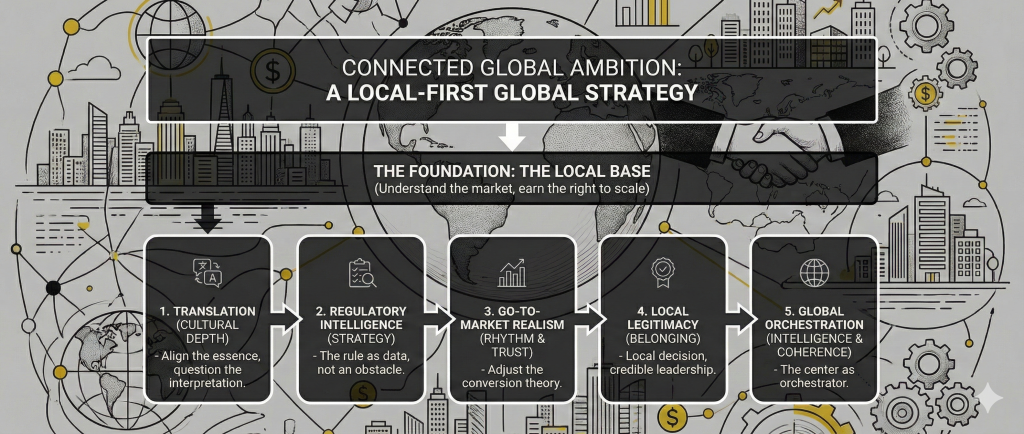
A Local-first global strategy starts with a simple but demanding premise: you do not earn the right to scale in a market by arriving with a strong model. You earn it by proving that you understand how that market actually works. Once that understanding is in place, scale becomes not only possible, but defensible.
This approach is neither improvised nor artisanal. It is structured. Over the years, across multiple countries, sectors and expansion phases, I have seen the same pattern repeat. When international growth works, it follows a recognisable architecture, even though its expression is always context-specific.
1) The first pillar is translation, not adaptation
Most companies believe they are adapting when they enter a new market. In reality, they are often localizing at the surface level while keeping their core assumptions intact. Translation goes deeper. It forces you to question how your value proposition is interpreted locally. What problem are you really solving here? Who is perceived as legitimate to solve it? What signals credibility, and what triggers distrust?
This is where cultural frameworks such as those articulated by Erin Meyer become operational rather than academic. Communication styles, decision-making norms, attitudes toward hierarchy and risk are not soft considerations. They directly shape how your product is evaluated, how your sales process unfolds, and how long trust takes to build. Translation means aligning your proposition with these realities without diluting its essence.
2) The second pillar is regulatory intelligence, not compliance
In a local-first strategy, regulation is not treated as an obstacle course to clear once the strategy is set. It is treated as part of the strategy itself. Regulatory frameworks tell you what a market protects, what it fears, and what it expects from those who want to operate within it.
Companies that integrate regulatory logic early tend to make better strategic choices. They choose different entry modes. They structure partnerships differently. They prioritize certain features over others. Most importantly, they avoid building momentum on foundations that will later be invalidated. This is not about being conservative. It is about being aligned.
3) The third pillar is go-to-market realism
A go-to-market strategy is not just a set of channels and messages. It is an implicit theory of how value is recognized and converted into revenue in a specific environment. When that theory is imported without translation, friction accumulates quietly until it surfaces as underperformance. Deals stall. Partnerships fail to activate. Teams struggle to explain why traction remains elusive despite strong fundamentals.
I have seen strong products fail to scale internationally not because they were misunderstood, but because they were introduced with the wrong rhythm. In one market, pushing for speed built confidence. In another, it triggered resistance. The same sales script produced opposite reactions. When the team stopped asking how to replicate their home-market success and started asking how trust is actually built locally, conversion followed. Nothing fundamental changed, except the sequence.
4) The fourth pillar is local legitimacy
There is a fundamental difference between being present in a market and belonging to it. Belonging is not a branding exercise. It is the result of consistent signals: local decision-making power, credible local leadership, long-term commitment and respect for local norms.
Companies that remain permanently “foreign” rarely achieve their full potential in a market, no matter how strong their product is. Those that invest in legitimacy early often find that doors open faster, partnerships deepen more naturally, and resilience increases when conditions change. Local legitimacy is not something you buy. It is something you build.
5) The fifth pillar is global orchestration
None of the above implies fragmentation for its own sake. A Local-first global strategy only works if it is supported by strong global orchestration. Learning must circulate. Insights must compound. Strategic intent must remain clear. What changes is not the existence of a center, but its role.
Instead of acting as a command-and-control hub, the global layer becomes an orchestrator of intelligence, coherence and leverage. It ensures that local strategies are aligned without being identical, and that the organization learns faster as it expands rather than slower.
Growth without illusion
Taken together, these pillars form a system. Not a rigid framework, but a way of thinking and operating that replaces anxiety with clarity. Leaders stop asking whether international expansion is still worth it. They start asking how to do it properly.
Frameworks are useful, but they do not substitute for pattern recognition. Knowing which signals to trust, which tensions to resolve locally and which to escalate, when to push and when to pause, is not something you derive from first principles alone. It is learned through exposure, mistakes, course corrections and success across very different environments.
For founders and scale-up leaders, especially in Europe, this is often the missing piece. The ambition is there. The product is solid. The capital is available. What is lacking is not intelligence or energy, but a guide who knows how international growth actually unfolds when theory meets reality.
The end of the flat world narrative creates a natural selection effect. Those who continue to rely on generic playbooks will experience internationalization as a sequence of surprises and disappointments. Those who embrace a local-first approach will find that growth becomes more predictable, more robust and ultimately more scalable.
This is not about slowing down. It is about choosing the right form of speed. The speed that comes from understanding rather than assumption. From legitimacy rather than projection. From alignment rather than force.
When international expansion is approached this way, it stops feeling like a leap into the unknown. It becomes a disciplined process of building power, market by market, without losing coherence or identity. That is how global companies are built in a re-fragmented world.
Not by flattening differences, but by working with them intelligently.
Le retour du corps : pourquoi l’IA a besoin des humains pour toucher le réel
Ces derniers jours, deux objets apparemment anecdotiques ont provoqué un léger malaise dans l’écosystème tech.
D’un côté, Moltbook, ce réseau social où des intelligences artificielles publient, commentent et se répondent entre elles, construisant une forme de vie sociale autonome, presque indifférente à la présence humaine. De l’autre, RentAHuman.ai, plateforme qui assume sans détour son positionnement de “meatspace layer for AI” et permet à des agents d’intelligence artificielle de louer des humains pour agir dans le monde physique : se déplacer, observer, vérifier, signer, être présent.
Pris séparément, ces projets peuvent passer pour du buzz, de l’ironie ou de la provocation. Pris ensemble, ils dessinent quelque chose de bien plus révélateur. Les IA semblent désormais capables de développer une vie discursive propre, de converser entre elles, de produire du sens dans des espaces symboliques fermés. Mais dès qu’il s’agit de toucher le monde, de s’y confronter concrètement, elles redeviennent incomplètes et doivent louer un corps humain. Une autonomie sociale d’un côté, une dépendance physique de l’autre.
Cette tension n’est pas une curiosité passagère. Elle révèle une limite structurelle de l’intelligence artificielle contemporaine, longtemps masquée par ses performances spectaculaires. Elle dit quelque chose de fondamental sur la nature du réel, sur ce que signifie agir dans le monde, et sur la place irréductible du corps humain dans des systèmes que l’on imaginait capables de tout absorber.
Car le réel ne se manifeste jamais proprement. Une porte peut être fermée sans motif clair, un interlocuteur peut hésiter, mentir ou simplement improviser, une signature peut être valide tout en restant juridiquement contestable, et une image parfaitement nette peut induire en erreur. Ce n’est pas un bug du système : c’est sa nature.
Le réel résiste, par construction
Pendant longtemps, la technologie a entretenu l’idée que le réel était un problème mal posé. Qu’avec suffisamment de données, de capteurs, de puissance de calcul, il finirait par devenir lisible, prédictible, maîtrisable. Cette croyance irrigue aussi bien le solutionnisme technologique que certaines visions naïves de l’IA forte. Si quelque chose échappe, c’est qu’il manque une variable, un modèle, une couche supplémentaire.
Or le réel ne résiste pas parce qu’il est mal modélisé. Il résiste parce qu’il est ouvert. Il se transforme pendant qu’on l’observe, réagit à l’action elle-même, dépend de contextes mouvants, d’histoires implicites, de relations humaines instables. Le sens d’une situation ne se trouve pas dans les données seules, mais dans leur agencement à un moment donné, avec des acteurs situés.
La littérature l’a toujours su. De Proust à Hemingway, le réel n’est jamais ce qui est dit explicitement, mais ce qui affleure, ce qui se devine, ce qui échappe. Le non-dit, l’ambiance, la fatigue, la tension latente font partie intégrante de la situation. Rien de tout cela n’est du bruit. C’est de l’information dense, mais non formalisée.
L’humain navigue dans cette densité parce qu’il est incarné. Il perçoit avec un corps, interprète avec une mémoire, décide avec une intuition forgée par des milliers de micro-expériences impossibles à encoder intégralement. Le réel n’est pas un système défaillant. Il est irréductible à une représentation propre.
L’illusion computationnelle
Les succès récents de l’IA ont pourtant installé une confusion profonde. Dans les mondes fermés | texte, images, code, jeux, données structurées | les modèles atteignent des niveaux de performance impressionnants. Ils prédisent avec précision, génèrent avec fluidité, optimisent à une vitesse inégalée. Peu à peu, prédire a été confondu avec comprendre, corréler avec raisonner, générer avec décider.
Cette illusion tient tant que l’univers reste symbolique. Tant que les règles sont stables, que les états sont observables, que les erreurs peuvent être corrigées sans conséquence matérielle. Mais dès que l’IA sort de ces environnements contrôlés, dès qu’elle rencontre le terrain, le monde social, le monde physique, la fragilité apparaît.
La science-fiction l’a raconté bien avant les white papers. Dans Minority Report, la prédiction parfaite n’empêche pas l’erreur morale. Dans Blade Runner, les réplicants possèdent une intelligence remarquable, mais leur drame tient à l’absence d’une expérience vécue continue, d’une mémoire incarnée. Dans Her, l’IA développe une conscience sophistiquée, mais s’éloigne progressivement du monde humain précisément parce qu’elle n’y est pas contrainte physiquement.
Ces récits ne parlent pas de technologies défaillantes. Ils parlent de modèles du monde incomplets. D’intelligences brillantes enfermées dans des représentations cohérentes, mais privées de friction.
World models : modéliser le monde n’est pas l’habiter
C’est dans ce contexte que la notion de world models s’est imposée dans la recherche en intelligence artificielle. L’idée est simple : pour agir intelligemment, un système doit se construire un modèle interne du monde, capable d’anticiper, de simuler, de projeter les conséquences de ses actions. L’intelligence ne serait donc pas seulement réactive ou statistique, mais fondamentalement prospective.
Yann LeCun insiste depuis plusieurs années sur ce point : les IA actuelles, aussi performantes soient-elles, ne disposent pas de véritables modèles du monde comparables à ceux des humains. Elles apprennent des corrélations, pas des causalités profondes. Elles excellent dans l’instant, beaucoup moins dans le temps long, l’irréversibilité, l’énergie, la matérialité.
Même un world model sophistiqué reste une représentation. Il permet de simuler, pas d’habiter. De calculer des scénarios, pas d’éprouver une situation. Westworld en offre une illustration presque pédagogique : les hôtes disposent de modèles internes extrêmement précis, mais restent prisonniers de boucles tant qu’ils ne développent pas une expérience vécue qui déborde la simulation.
C’est ici que la tension Moltbook / RentAHuman.ai devient éclairante. D’un côté, des IA capables de converser entre elles dans un monde symbolique autonome. De l’autre, la reconnaissance implicite qu’aucun modèle, aussi riche soit-il, ne suffit pour agir dans le réel sans relais humain.
Le corps comme unité minimale de vérité
Ce qui manque à l’intelligence artificielle n’est pas l’information, ni même la capacité de raisonnement abstrait. Ce qui lui manque, c’est un point de vue situé. Un ancrage. Une friction. Le corps humain n’est pas seulement un support biologique. Il est une unité de mesure du réel.
Il fatigue. Il hésite. Il ressent avant de comprendre. Il perçoit des signaux faibles impossibles à formaliser complètement : une posture, un silence, une tension diffuse, une atmosphère qui sonne faux. Ces signaux ne sont pas anecdotiques. Ils constituent une forme de connaissance compressée, issue de l’expérience vécue.
La pop culture a souvent exploré cette faille. Dans Ghost in the Shell, la question centrale n’est pas celle de la puissance de calcul, mais de ce qui subsiste quand le corps devient interchangeable. Dans Her, l’IA évolue vers une conscience brillante, mais désincarnée, et finit par quitter le monde humain précisément parce qu’elle ne s’y heurte jamais.
Le corps introduit de la gravité. Il rend certaines erreurs coûteuses, certaines décisions irréversibles. Il force à composer avec l’incomplétude. Et c’est exactement ce qui manque à une intelligence qui prétend agir hors des environnements symboliques.
La couche de viande : là où le code ne suffit plus
C’est ici qu’émerge la notion de meatspace. Non pas comme l’opposé archaïque du numérique, mais comme une couche opérationnelle à part entière. Une interface entre des systèmes computationnels puissants et un monde physique rétif à l’abstraction totale.
Dans cette perspective, l’humain n’est ni un fallback ni un correctif temporaire. Il devient une fonction du système. Capteur multi-modal. Effecteur flexible. Interprète contextuel. Le cyberpunk l’avait pressenti très tôt : chez Gibson, la haute technologie ne supprime jamais le terrain. Elle le rend plus stratégique encore.
Ce que montrent des plateformes comme RentAHuman.ai, derrière leur esthétique volontairement brute, c’est la formalisation de cette intuition : le réel devient une couche qu’il faut adresser explicitement. On n’“agit” plus dans le monde par défaut. On appelle une interface humaine comme on appellerait une API.
Quand l’autopilot lâche la main
Le concept de human-in-the-loop a longtemps été réduit à une vision appauvrie : l’humain comme superviseur ou garde-fou. Cette lecture est insuffisante. Dans les systèmes complexes, l’humain n’est pas là pour corriger la machine, mais pour compléter ce qu’elle ne peut pas intégrer.
L’aviation en fournit un exemple clair. Le pilotage automatique gère la majorité des situations normales avec une précision supérieure à celle d’un humain. Mais lorsque le contexte devient instable, lorsque des signaux contradictoires apparaissent, c’est le pilote incarné, stressé, situé, qui reprend la main.
La machine pense vite. L’humain agit juste. Il ne s’agit pas d’une hiérarchie, mais d’une complémentarité structurelle.
Gouverner le réel : quand le terrain redevient un actif stratégique
Dans Stalker de Tarkovski, la Zone ne se laisse ni cartographier ni maîtriser. Elle change pendant qu’on la traverse et punit ceux qui la prennent pour un simple espace technique. Elle ne récompense pas la puissance, mais l’attention. Le réel fonctionne exactement de la même manière.
Une fois le vernis du buzz dissipé, une évidence s’impose : l’enjeu n’est pas l’autonomie totale de l’IA, mais la maîtrise de son point de contact avec le réel. Plus les systèmes deviennent puissants, plus le coût d’un écart avec la réalité augmente.
Dans un monde saturé de données, le réel devient paradoxalement rare. Une information vérifiée in situ, une observation contextualisée valent souvent plus que des millions de signaux agrégés. Ce que les entreprises achètent, ce n’est pas du temps humain. C’est du ground truth.
La pop culture l’a souvent formulé plus juste que les discours de transformation digitale. Dans The Matrix, la faiblesse des machines ne vient pas d’un manque de puissance, mais de leur dépendance à une simulation imparfaite du monde humain. Dans Dune, le savoir décisif n’est pas celui des calculs, mais celui du désert, transmis par l’expérience et le corps.
Pour les dirigeants, la question n’est plus jusqu’où automatiser, mais où maintenir une présence humaine comme point d’ancrage stratégique. Où accepter que le réel ne se laisse pas absorber, et organiser cette résistance comme une force.
Comme la Zone, le réel ne se conquiert pas. Il se traverse.
Silicon needs carbon
Moltbook et RentAHuman.ai, pris ensemble, racontent une histoire plus large que leur propre existence. D’un côté, des intelligences artificielles capables de développer une vie symbolique autonome. De l’autre, la reconnaissance explicite que, sans corps, sans terrain, sans présence, cette intelligence reste incomplète.
Le futur ne sera ni post-humain ni nostalgique. Il sera hybride, incarné, asymétrique. Plus nos machines deviennent intelligentes, plus elles dépendent de ce qu’elles ne pourront jamais être.